

GLP-1 & Weight Loss GLP-1 Explained: What to Expect in Your First 90 Days A plain-language guide to your first 90 days on semaglutide or tirzepatide — including what to expect, what’s normal, and how to build momentum. By Lifted Health Updated: June 2026 8 min read Starting a GLP-1 medication is one of the most clinically supported treatment paths for sustainable weight loss. But the first 90 days are also where most patients have the most questions, the most uncertainty, and the highest risk of stopping too early. The early phase is not about perfection. It is about adjustment. Your body is learning the medication, your appetite is changing, and your routines are starting to shift. The patients who succeed long term are usually the ones who understand what is normal, stay consistent, and build the right habits before judging the outcome too early. Key Takeaway The first 90 days are the foundation, not the finish line. Appetite changes often start early, meaningful weight loss usually builds over weeks 4–12, and the strongest results compound over 6–18 months with consistency. Download the Free GLP-1 First 90 Days Guide Get the full Lifted Health patient education guide covering what to expect, common side effects, weekly milestones, and how to set yourself up for better results during your first three months. Download the Free Guide → Why the First 90 Days Matter Clinical trials for semaglutide and tirzepatide show average weight loss in the range of roughly 15–22% of body weight over longer treatment timelines. But those outcomes do not happen overnight. They are built on the foundation created in the first three months: tolerating the starting dose, adjusting eating patterns, learning how your body responds, and building consistency with injections, hydration, protein, and movement. This is where expectations matter. If you expect dramatic weight loss in the first two weeks, you may think the medication is not working. In reality, the first month is usually about tolerability and appetite adjustment, not maximum results. First 90 Days Snapshot Weeks 1–4 are about adjustment. Weeks 5–8 are where appetite suppression usually becomes more noticeable. Weeks 9–12 are where routines start clicking and momentum becomes more predictable. How GLP-1 Medications Work GLP-1 stands for glucagon-like peptide-1, a hormone your body naturally produces after eating. GLP-1 medications mimic this hormone at a sustained level, helping your body regulate appetite, fullness, digestion, and blood sugar more effectively. These medications do not work through one single pathway. They affect multiple systems at the same time. Brain: Stronger satiety signals GLP-1 medications help your brain receive stronger and longer-lasting fullness signals. Many patients describe this as reduced “food noise” — fewer cravings, less snacking, and less constant thinking about food. Stomach: Slower gastric emptying Food stays in your stomach longer, which helps you feel full on smaller portions. This is also why large, greasy, or high-fat meals can trigger nausea during treatment. Pancreas and liver: Better metabolic signaling GLP-1 medications help stimulate insulin release when blood sugar rises and reduce excess glucose output from the liver. This supports better metabolic function without forcing blood sugar down in the same way some older medications can. Semaglutide vs. Tirzepatide Semaglutide and tirzepatide both work through GLP-1 pathways, but they are not identical. Semaglutide is a GLP-1 receptor agonist. Tirzepatide activates both GLP-1 and GIP pathways, giving it a dual-action mechanism. In clinical trials, tirzepatide has generally produced greater average weight loss, while both medications are strong options when prescribed appropriately. Semaglutide vs. Tirzepatide Feature Semaglutide Tirzepatide Mechanism GLP-1 agonist GLP-1 + GIP dual agonist Injection frequency Once weekly Once weekly Average trial weight loss Around 15% body weight Around 20–22% body weight Common side effects Nausea and GI changes Nausea, GI changes, and possible fatigue Your 90-Day GLP-1 Roadmap GLP-1 therapy usually follows a structured titration process. You start low, then gradually increase the dose based on tolerability and provider guidance. This approach is intentional. It helps your body adapt and reduces the risk of stronger side effects. Weeks 1–4: Starting dose and adjustment Your body is meeting the medication for the first time. Most patients notice reduced appetite, smaller portions, and possibly mild nausea or fatigue around injection day. This phase is not about speed. It is about tolerability. You may not see dramatic weight loss yet, and that is normal. Focus on smaller meals, hydration, protein, and learning what foods sit well. Weeks 5–8: First dose increase and appetite shifts If you tolerate the starting dose well, your provider may recommend moving to the next dose. This is often when the medication starts to feel different. Food noise may quiet more noticeably, portion sizes may shrink further, and week-over-week weight loss may become more visible. Nausea may briefly return after a dose increase. That is expected and usually settles within a few days. Weeks 9–12: Finding your groove By this point, many patients feel more settled. Injection timing is consistent, eating patterns are adapted, and side effects often decrease. Around weeks 8–10 is when many patients report that treatment starts to “click.” The medication, eating patterns, hydration, protein, movement, and sleep start working together. Month 4 and beyond: Continued titration Most patients are not at their target dose by day 90. Weight loss continues to build over months, not days. The first 90 days create the operating system. The longer-term results come from continuing that system consistently. Do Not Judge Too Early The first four weeks are the adjustment phase, not the results phase. Stopping early is one of the biggest reasons patients fail to capture the full upside of GLP-1 therapy. Side Effects: What Is Normal? GLP-1 medications have a predictable side effect profile. Most side effects are temporary, manageable, and related to slower digestion or dose changes. Nausea Nausea is the most common side effect, especially in the first few weeks or after dose increases. It is usually mild, peaks within the first day or two after injection, and fades within a few days.
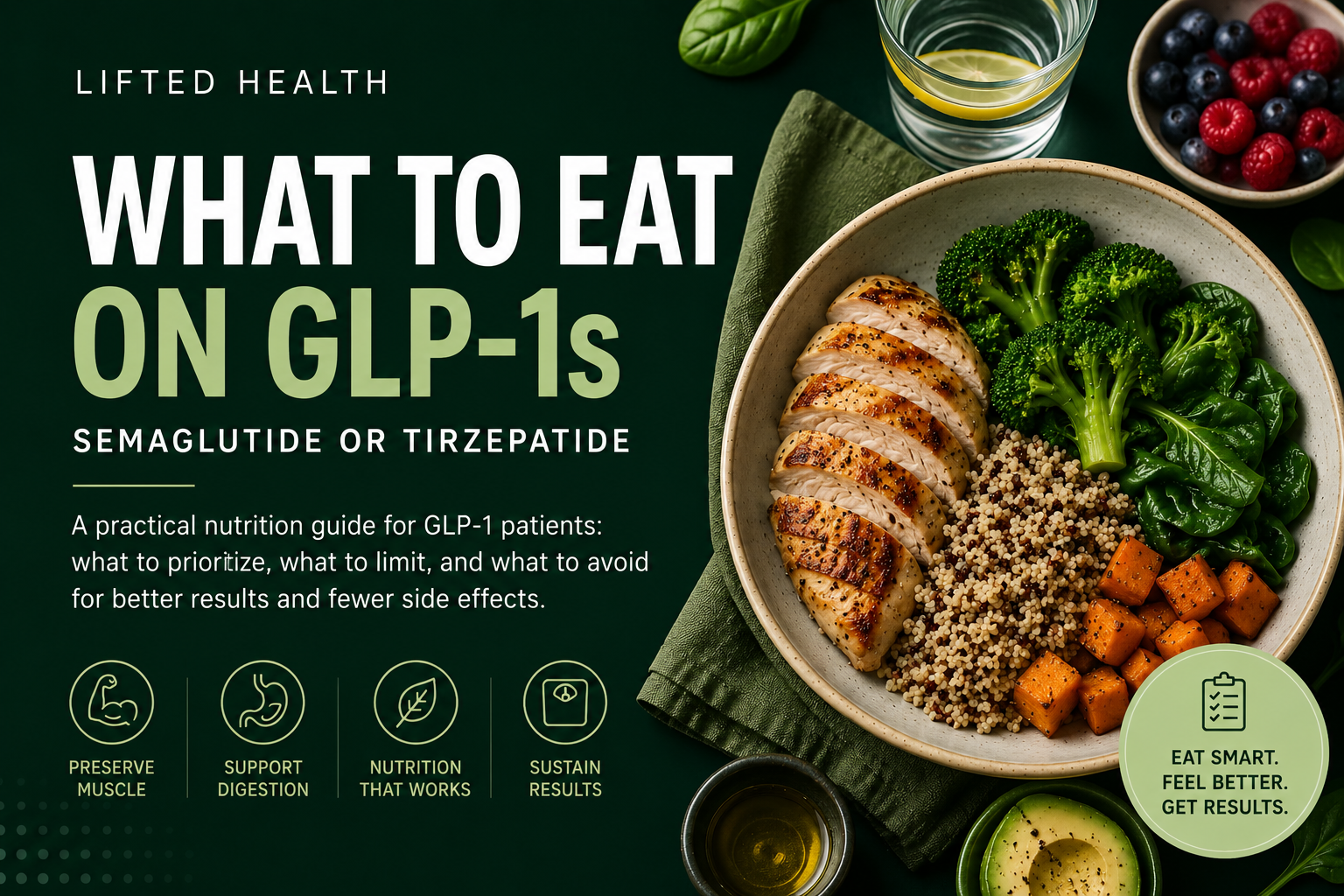
The Best Foods to Eat on Semaglutide or Tirzepatide (And What to Avoid)
GLP-1 medications suppress appetite — but what you eat still matters. Here’s the practical nutrition guide for semaglutide and tirzepatide patients.

How to Maximize Weight Loss on Semaglutide: The Protocol Most People Miss
The medication handles appetite. The protocol handles everything else. Here’s how to pair semaglutide with the right nutrition, training, and injectable support.

Lipo-C Injections: What’s Actually in the ‘Fat-Burning Shot’?
Lipo-C is one of the most searched injectable wellness treatments — and one of the least understood. Here’s the science behind what you’re actually injecting.

Semaglutide vs. Tirzepatide: Which GLP-1 Is Right for Your Body?
Semaglutide and tirzepatide are both GLP-1 medications — but they work differently. Learn which one fits your metabolism, side effect tolerance, and weight loss goals.